Samuel White 60 ft Motor Yacht 1914
T: +44(0)1202 330077
E: info@sandemanyachtcompany.co.uk
W: www.sandemanyachtcompany.co.uk
NORTHERN KIWI
|
|
![]() |
Samuel White 60 ft Motor Yacht 1914
NORTHERN KIWI
BROKERS COMMENTS
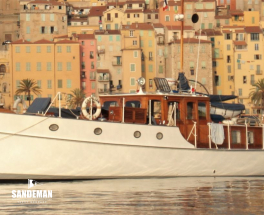
From the board and Cowes yard of Samuel White, KIWI – despite her name in recognition of her Kauri pine construction, was launched as a thoroughly English gentleman’s yacht – one of considerable style but of manageable size. Her current owner has undertaken the lion’s share of her restoration. She is now an exciting prospect at a sensible price for a new owner to complete.
CONSTRUCTION AND RESTORATION
Hull
- Original kauri pine hull and deck with teak trim and deckhouses
- False keel removed and full length greenheart keel put in place with new bolts
- Estimated 30% planking replaced with pitch pine under the water line and larch above
- Hull has been epoxy splined from keel up and refastened where needed
- All copper rivets hardened
- Framing is elm timbers spaced between oak frames - again circa 30% replaced
- Deadwoods refastened and engine bearers replaced
- Stringers, gunwales and beam shelves replaced with pitch pine
- Structural timbers have been copper clenched with ½ inch copper round bar as was original
- Horn timber renewed as was the top section of stem
- Stem and stern knee replaced
Deck
- 100% replaced using 1 ¼ inch marine ply bronze nailed and ¼ “ teak 19 ft lengths epoxied
- Beams, carlins and all structural timber fastened as original ½ inch bar clenched
- Fore steel bulkhead is new and 50% of the aft bulkhead replaced with ¼ inch steel
- All coamings are 1 ½ - 2 inch solid teak also copper clenched through
- Covering boards are 1 ½ inch iroko
- Deck saloon is 2 inch teak.
- Skylight and companionway are 1 ½ inch teak
- After section of doghouse, grating and cockpit coaming are all that remain of original deckhouses
TIMBER FOR COMPLETION
Large quantities of seasoned timbers are available including pitch pine, teak, mahoganies, oak, ash and American black walnut. There is more than enough timber to complete the vessel.
HISTORY
Launched as KIWI she was soon to be requisitioned for the war effort - and the owner’s son served as her lieutenant. Following the Great War, she passed through various owners before being taken again for the 2nd World War. For this she was stripped of all her original deckhouses and an admiralty pattern wheel house built on deck. After the war she served as a salvage vessel before being laid up to become a \"chippy\" in Northwich. Found by her present owner in 1991, she was relaunched in 2008 ready for fitting out.
ACCOMMODATION
The fore accommodation is nearly complete with a cabin that has four berths fitted out in solid teak with sapele sole and a head with the shower also planned. The 10 foot long engine room with standing headroom is also fitted out but needs finishing with a workbench and battery tray. The aft section is a blank canvas; not fitted out at all but has the bearers laid ready for it. She still needs two skylights and two companionways to be made plus the funnel.
FIXED HARDWARE
- Shaft is 30 ft long in three sections
- (Mid sections replaced with steel, after section replaced with 316 s/s)
- New plumber block bushes
- New glands in stern tube and new bronze bush at inner part of stern tube
- New propellor and new flexible coupling from shaft to box
- Recon Gardner engine by Walsh of Manchester
- New 316 s/s fuel tanks
- New 9 KVA generator
- New fresh water tanks and pumps
- New waste tank and pump
- Steering is currently being replaced with a new hydraulic system
- New anchor capstan
- Head refurnished
- Fore cabin is fitted out in solid teak with a sapele sole
- Bulkheads are of mahogany - painted
WORK IN PROGRESS
Work continues on the engine room skylight and deckhead on which the funnel is also positioned, the companionway, steering platform and saloon skylight, all of which are parts of an integrated section.
DISCLAIMER
These particulars have been prepared from information provided by the vendors and are intended as general guide. The purchaser should confirm details of concern to them by survey or engineers inspection. The purchaser should also ensure that the purchase contract properly reflects their concerns and specifies details on which they wish to rely.
BROKERS COMMENTS
From the board and Cowes yard of Samuel White, KIWI – despite her name in recognition of her Kauri pine construction, was launched as a thoroughly English gentleman’s yacht – one of considerable style but of manageable size. Her current owner has undertaken the lion’s share of her restoration. She is now an exciting prospect at a sensible price for a new owner to complete.
HISTORY
Launched as KIWI she was soon to be requisitioned for the war effort - and the owner’s son served as her lieutenant. Following the Great War, she passed through various owners before being taken again for the 2nd World War. For this she was stripped of all her original deckhouses and an admiralty pattern wheel house built on deck. After the war she served as a salvage vessel before being laid up to become a "chippy" in Northwich. Found by her present owner in 1991, she was relaunched in 2008 ready for fitting out.
CONSTRUCTION AND RESTORATION
Hull
- Original kauri pine hull and deck with teak trim and deckhouses
- False keel removed and full length greenheart keel put in place with new bolts
- Estimated 30% planking replaced with pitch pine under the water line and larch above
- Hull has been epoxy splined from keel up and refastened where needed
- All copper rivets hardened
- Framing is elm timbers spaced between oak frames - again circa 30% replaced
- Deadwoods refastened and engine bearers replaced
- Stringers, gunwales and beam shelves replaced with pitch pine
- Structural timbers have been copper clenched with ½ inch copper round bar as was original
- Horn timber renewed as was the top section of stem
- Stem and stern knee replaced
Deck
- 100% replaced using 1 ¼ inch marine ply bronze nailed and ¼ “ teak 19 ft lengths epoxied
- Beams, carlins and all structural timber fastened as original ½ inch bar clenched
- Fore steel bulkhead is new and 50% of the aft bulkhead replaced with ¼ inch steel
- All coamings are 1 ½ - 2 inch solid teak also copper clenched through
- Covering boards are 1 ½ inch iroko
- Deck saloon is 2 inch teak.
- Skylight and companionway are 1 ½ inch teak
- After section of doghouse, grating and cockpit coaming are all that remain of original deckhouses
ACCOMMODATION
The fore accommodation is nearly complete with a cabin that has four berths fitted out in solid teak with sapele sole and a head with the shower also planned. The 10 foot long engine room with standing headroom is also fitted out but needs finishing with a workbench and battery tray. The aft section is a blank canvas; not fitted out at all but has the bearers laid ready for it. She still needs two skylights and two companionways to be made plus the funnel.
FIXED HARDWARE
- Shaft is 30 ft long in three sections
- (Mid sections replaced with steel, after section replaced with 316 s/s)
- New plumber block bushes
- New glands in stern tube and new bronze bush at inner part of stern tube
- New propellor and new flexible coupling from shaft to box
- Recon Gardner engine by Walsh of Manchester
- New 316 s/s fuel tanks
- New 9 KVA generator
- New fresh water tanks and pumps
- New waste tank and pump
- Steering is currently being replaced with a new hydraulic system
- New anchor capstan
- Head refurnished
- Fore cabin is fitted out in solid teak with a sapele sole
- Bulkheads are of mahogany - painted
WORK IN PROGRESS
Work continues on the engine room skylight and deckhead on which the funnel is also positioned, the companionway, steering platform and saloon skylight, all of which are parts of an integrated section.
TIMBER FOR COMPLETION
Large quantities of seasoned timbers are available including pitch pine, teak, mahoganies, oak, ash and American black walnut. There is more than enough timber to complete the vessel.
DISCLAIMER
These particulars have been prepared from information provided by the vendors and are intended as a general guide. The purchaser should confirm details of concern to them by survey or engineers inspection. The purchaser should also ensure that the purchase contract properly reflects their concerns and specifies details on which they wish to rely.