 +44 (0)1202 330077
+44 (0)1202 330077
+44 (0)1202 330077
![ORIANDA - Oscar W. Dahlström 74 ft Staysail Schooner 1937/2025 [Photo: Francesco Rastrelli/ Blue Passion]](https://images.sandemanyachtcompany.co.uk/uploads/boats/142x100_781_30540817568fa0351ddff2.jpg)
![ORIANDA - Oscar W. Dahlström 74 ft Staysail Schooner 1937/2025 [Photo: Francesco Rastrelli/ Blue Passion] [Photo: Francesco Rastrelli/ Blue Passion]](https://images.sandemanyachtcompany.co.uk/uploads/boats/142x100_781_115852778568ed268a73045.jpg)

![Saloon [Photo: Francesco Rastrelli/ Blue Passion]](https://images.sandemanyachtcompany.co.uk/uploads/boats/142x100_781_170591389468fe1716d2ea8.jpg)
![[Photo: Francesco Rastrelli/ Blue Passion]](https://images.sandemanyachtcompany.co.uk/uploads/boats/142x100_781_207724985468fa034ad6579.jpg)
![[Photo: Francesco Rastrelli/ Blue Passion]](https://images.sandemanyachtcompany.co.uk/uploads/boats/142x100_781_113976735168fa034c138b9.jpg)
![[Photo: Francesco Rastrelli/ Blue Passion]](https://images.sandemanyachtcompany.co.uk/uploads/boats/142x100_781_129972306668fa034cc850a.jpg)
![[Photo: Francesco Rastrelli/ Blue Passion]](https://images.sandemanyachtcompany.co.uk/uploads/boats/142x100_781_165297649468fa034d85f36.jpg)
![[Photo: Francesco Rastrelli/ Blue Passion]](https://images.sandemanyachtcompany.co.uk/uploads/boats/142x100_781_153453864368fa034e23c6d.jpg)
![[Photo: Francesco Rastrelli/ Blue Passion]](https://images.sandemanyachtcompany.co.uk/uploads/boats/142x100_781_185496580368fa0351273f9.jpg)
![[Photo: Francesco Rastrelli/ Blue Passion]](https://images.sandemanyachtcompany.co.uk/uploads/boats/142x100_781_32614779468fa0353bbf58.jpg)
![[Photo: Francesco Rastrelli/ Blue Passion]](https://images.sandemanyachtcompany.co.uk/uploads/boats/142x100_781_162094183268fa035489ec1.jpg)
![[Photo: Francesco Rastrelli/ Blue Passion]](https://images.sandemanyachtcompany.co.uk/uploads/boats/142x100_781_128932219068fa0355b6c2c.jpg)
![Abeam [Photo: Francesco Rastrelli/ Blue Passion]](https://images.sandemanyachtcompany.co.uk/uploads/boats/142x100_781_128740053068fa035b5c2f0.jpg)
![[Photo: Francesco Rastrelli/ Blue Passion]](https://images.sandemanyachtcompany.co.uk/uploads/boats/142x100_781_201403776668fa141711adf.jpg)
![[Photo: Francesco Rastrelli/ Blue Passion]](https://images.sandemanyachtcompany.co.uk/uploads/boats/142x100_781_150529104068fa1417ea050.jpg)
![[Photo: Francesco Rastrelli/ Blue Passion]](https://images.sandemanyachtcompany.co.uk/uploads/boats/142x100_781_181064330468fa141915e78.jpg)
![[Photo: Francesco Rastrelli/ Blue Passion]](https://images.sandemanyachtcompany.co.uk/uploads/boats/142x100_781_65595606068fa141a47805.jpg)
![[Photo: Francesco Rastrelli/ Blue Passion]](https://images.sandemanyachtcompany.co.uk/uploads/boats/142x100_781_49182597268fa141b34844.jpg)
![[Photo: Francesco Rastrelli/ Blue Passion]](https://images.sandemanyachtcompany.co.uk/uploads/boats/142x100_781_203802083468fa141c1396d.jpg)
![[Photo: Francesco Rastrelli/ Blue Passion]](https://images.sandemanyachtcompany.co.uk/uploads/boats/142x100_781_192811660168fa141cf15f0.jpg)
![[Photo: Francesco Rastrelli/ Blue Passion]](https://images.sandemanyachtcompany.co.uk/uploads/boats/142x100_781_141848019968fa141e6c302.jpg)
![[Photo: Francesco Rastrelli/ Blue Passion]](https://images.sandemanyachtcompany.co.uk/uploads/boats/142x100_781_124269784268fb65426a411.jpg)
![[Photo: Francesco Rastrelli/ Blue Passion]](https://images.sandemanyachtcompany.co.uk/uploads/boats/142x100_781_198934022568fb6543269b8.jpg)
![[Photo: Francesco Rastrelli/ Blue Passion]](https://images.sandemanyachtcompany.co.uk/uploads/boats/142x100_781_127686106468fb6543de3e3.jpg)
![[Photo: Francesco Rastrelli/ Blue Passion]](https://images.sandemanyachtcompany.co.uk/uploads/boats/142x100_781_192746096368fb65449da34.jpg)
![[Photo: Francesco Rastrelli/ Blue Passion]](https://images.sandemanyachtcompany.co.uk/uploads/boats/142x100_781_153564967968fb6545543a9.jpg)
![[Photo: Francesco Rastrelli/ Blue Passion]](https://images.sandemanyachtcompany.co.uk/uploads/boats/142x100_781_113820629368fb6547d05d2.jpg)
![[Photo: Francesco Rastrelli/ Blue Passion]](https://images.sandemanyachtcompany.co.uk/uploads/boats/142x100_781_172963774668fb65465b819.jpg)
![[Photo: Francesco Rastrelli/ Blue Passion]](https://images.sandemanyachtcompany.co.uk/uploads/boats/142x100_781_127634656568fb65471804d.jpg)
![[Photo: Francesco Rastrelli/ Blue Passion]](https://images.sandemanyachtcompany.co.uk/uploads/boats/142x100_781_28915093168fb6548a0740.jpg)
![[Photo: Francesco Rastrelli/ Blue Passion]](https://images.sandemanyachtcompany.co.uk/uploads/boats/142x100_781_147008206568fb654a1f499.jpg)
![[Photo: Francesco Rastrelli/ Blue Passion]](https://images.sandemanyachtcompany.co.uk/uploads/boats/142x100_781_77230956868fb654ac5341.jpg)
![[Photo: Francesco Rastrelli/ Blue Passion]](https://images.sandemanyachtcompany.co.uk/uploads/boats/142x100_781_46461854768fb655246e22.jpg)
![[Photo: Francesco Rastrelli/ Blue Passion]](https://images.sandemanyachtcompany.co.uk/uploads/boats/142x100_781_5128304068fb6554ddf15.jpg)
![[Photo: Francesco Rastrelli/ Blue Passion]](https://images.sandemanyachtcompany.co.uk/uploads/boats/142x100_781_65390970268fb6555e2eaf.jpg)
![[Photo: Francesco Rastrelli/ Blue Passion]](https://images.sandemanyachtcompany.co.uk/uploads/boats/142x100_781_167320734968fb65582cf45.jpg)
![[Photo: Francesco Rastrelli/ Blue Passion]](https://images.sandemanyachtcompany.co.uk/uploads/boats/142x100_781_19091496168fb6553eb120.jpg)
![[Photo: Francesco Rastrelli/ Blue Passion]](https://images.sandemanyachtcompany.co.uk/uploads/boats/142x100_781_81616639468fb655723243.jpg)
![[Photo: Francesco Rastrelli/ Blue Passion]](https://images.sandemanyachtcompany.co.uk/uploads/boats/142x100_781_9943995968fb655b155de.jpg)
![[Photo: Francesco Rastrelli/ Blue Passion]](https://images.sandemanyachtcompany.co.uk/uploads/boats/142x100_781_72650073468fb655a26fcc.jpg)
![[Photo: Francesco Rastrelli/ Blue Passion]](https://images.sandemanyachtcompany.co.uk/uploads/boats/142x100_781_186289343168fb655ed21fa.jpg)
![[Photo: Francesco Rastrelli/ Blue Passion]](https://images.sandemanyachtcompany.co.uk/uploads/boats/142x100_781_3120379668fb656155b9f.jpg)
![[Photo: Francesco Rastrelli/ Blue Passion]](https://images.sandemanyachtcompany.co.uk/uploads/boats/142x100_781_116052407868fb656474dd9.jpg)
![[Photo: Francesco Rastrelli/ Blue Passion]](https://images.sandemanyachtcompany.co.uk/uploads/boats/142x100_781_84585544468fb65652588d.jpg)
![[Photo: Francesco Rastrelli/ Blue Passion]](https://images.sandemanyachtcompany.co.uk/uploads/boats/142x100_781_61551200268fb6566014ba.jpg)
![[Photo: Francesco Rastrelli/ Blue Passion]](https://images.sandemanyachtcompany.co.uk/uploads/boats/142x100_781_39220112868fbb9ec6f93b.jpg)
![[Photo: Francesco Rastrelli/ Blue Passion]](https://images.sandemanyachtcompany.co.uk/uploads/boats/142x100_781_9672523668fbb9ed5746f.jpg)
![[Photo: Francesco Rastrelli/ Blue Passion]](https://images.sandemanyachtcompany.co.uk/uploads/boats/142x100_781_175822092068fbb9ee05733.jpg)
![[Photo: Francesco Rastrelli/ Blue Passion]](https://images.sandemanyachtcompany.co.uk/uploads/boats/142x100_781_120466608868fbb9eea94e5.jpg)
![[Photo: Francesco Rastrelli/ Blue Passion]](https://images.sandemanyachtcompany.co.uk/uploads/boats/142x100_781_191351225868fbb9ef75d60.jpg)
![Main Companiponway [Photo: Francesco Rastrelli/ Blue Passion]](https://images.sandemanyachtcompany.co.uk/uploads/boats/142x100_781_57002963268fe2655dd653.jpg)
![Aft lobby view aft [Photo: Francesco Rastrelli/ Blue Passion]](https://images.sandemanyachtcompany.co.uk/uploads/boats/142x100_781_98986917668fcb05759602.jpg)
![Aft lobby view forward [Photo: Francesco Rastrelli/ Blue Passion]](https://images.sandemanyachtcompany.co.uk/uploads/boats/142x100_781_211756321368fcb058ea1f4.jpg)
![Aft lobby view forward [Photo: Francesco Rastrelli/ Blue Passion]](https://images.sandemanyachtcompany.co.uk/uploads/boats/142x100_781_31116369868fcb058404cd.jpg)
![Saloon forward [Photo: Francesco Rastrelli/ Blue Passion]](https://images.sandemanyachtcompany.co.uk/uploads/boats/142x100_781_10442532268fcb3dada07c.jpg)
![Saloon forward to port [Photo: Francesco Rastrelli/ Blue Passion]](https://images.sandemanyachtcompany.co.uk/uploads/boats/142x100_781_193899158368fcb3d40692a.jpg)
![Saloon to port [Photo: Francesco Rastrelli/ Blue Passion]](https://images.sandemanyachtcompany.co.uk/uploads/boats/142x100_781_210992051468fcb3d4aff62.jpg)
![Saloon to port [Photo: Francesco Rastrelli/ Blue Passion]](https://images.sandemanyachtcompany.co.uk/uploads/boats/142x100_781_190497974768fcb3d588374.jpg)
![Saloon to port [Photo: Francesco Rastrelli/ Blue Passion]](https://images.sandemanyachtcompany.co.uk/uploads/boats/142x100_781_127738207468fcb3d653de1.jpg)
![Saloon skylight [Photo: Francesco Rastrelli/ Blue Passion]](https://images.sandemanyachtcompany.co.uk/uploads/boats/142x100_781_213707444568fcb3d72f042.jpg)
![Saloon skylight details [Photo: Francesco Rastrelli/ Blue Passion]](https://images.sandemanyachtcompany.co.uk/uploads/boats/142x100_781_105060391468fcb66619837.jpg)
![Saloon forward to starboard [Photo: Francesco Rastrelli/ Blue Passion]](https://images.sandemanyachtcompany.co.uk/uploads/boats/142x100_781_983328268fcb3d8a6953.jpg)
![Saloon to starboard [Photo: Francesco Rastrelli/ Blue Passion]](https://images.sandemanyachtcompany.co.uk/uploads/boats/142x100_781_202647403368fcb3d9809fa.jpg)
![Saloon to starboard [Photo: Francesco Rastrelli/ Blue Passion]](https://images.sandemanyachtcompany.co.uk/uploads/boats/142x100_781_167066657568fcb3da37a82.jpg)
![Forward passage [Photo: Francesco Rastrelli/ Blue Passion]](https://images.sandemanyachtcompany.co.uk/uploads/boats/142x100_781_144351233768fcb4427f54b.jpg)
![Starboard forward twin cabin [Photo: Francesco Rastrelli/ Blue Passion]](https://images.sandemanyachtcompany.co.uk/uploads/boats/142x100_781_166451098768fcb43fa9433.jpg)
![Port forward twin cabin [Photo: Francesco Rastrelli/ Blue Passion]](https://images.sandemanyachtcompany.co.uk/uploads/boats/142x100_781_30980614168fcb4405ad88.jpg)
![Passage forward to galley [Photo: Francesco Rastrelli/ Blue Passion]](https://images.sandemanyachtcompany.co.uk/uploads/boats/142x100_781_4553864968fcb4414b9a1.jpg)
![Galley via forward companionway [Photo: Francesco Rastrelli/ Blue Passion]](https://images.sandemanyachtcompany.co.uk/uploads/boats/142x100_781_198612481868fcb4ef355ad.jpg)
![Galley view forward [Photo: Francesco Rastrelli/ Blue Passion]](https://images.sandemanyachtcompany.co.uk/uploads/boats/142x100_781_211357937668fcb4f04c2be.jpg)
![Crew mess to starboard [Photo: Francesco Rastrelli/ Blue Passion]](https://images.sandemanyachtcompany.co.uk/uploads/boats/142x100_781_30063284468fcb4f19d3df.jpg)
![Galley from crew mess [Photo: Francesco Rastrelli/ Blue Passion]](https://images.sandemanyachtcompany.co.uk/uploads/boats/142x100_781_52974322768fcb4f2b8b60.jpg)
![Crew accomm and mess from Galley [Photo: Francesco Rastrelli/ Blue Passion]](https://images.sandemanyachtcompany.co.uk/uploads/boats/142x100_781_31684375568fcb4f3e6482.jpg)
![Crew cabin view forward [Photo: Francesco Rastrelli/ Blue Passion]](https://images.sandemanyachtcompany.co.uk/uploads/boats/142x100_781_208292340468fcb5122a4f7.jpg)
![Crew cabin view forward [Photo: Francesco Rastrelli/ Blue Passion]](https://images.sandemanyachtcompany.co.uk/uploads/boats/142x100_781_188189639868fcb5141f62b.jpg)
![Crew WC/ shower [Photo: Francesco Rastrelli/ Blue Passion]](https://images.sandemanyachtcompany.co.uk/uploads/boats/142x100_781_129366052268fcb512e16fb.jpg)
![Galley view aft [Photo: Francesco Rastrelli/ Blue Passion]](https://images.sandemanyachtcompany.co.uk/uploads/boats/142x100_781_87716348368fcb4f4e1f77.jpg)
![View aft to starboard from galley [Photo: Francesco Rastrelli/ Blue Passion]](https://images.sandemanyachtcompany.co.uk/uploads/boats/142x100_781_39744105968fcb4f6b0d08.jpg)
![Forward passage view aft [Photo: Francesco Rastrelli/ Blue Passion]](https://images.sandemanyachtcompany.co.uk/uploads/boats/142x100_781_68673892168fcb55b253f7.jpg)
![Forward passage view aft [Photo: Francesco Rastrelli/ Blue Passion]](https://images.sandemanyachtcompany.co.uk/uploads/boats/142x100_781_132382829668fcb55bc74e4.jpg)
![Port forward cabin view aft [Photo: Francesco Rastrelli/ Blue Passion]](https://images.sandemanyachtcompany.co.uk/uploads/boats/142x100_781_62525804768fcb55c76201.jpg)
![Port forward cabin view aft [Photo: Francesco Rastrelli/ Blue Passion]](https://images.sandemanyachtcompany.co.uk/uploads/boats/142x100_781_2783142368fcb55d8bff7.jpg)
![Port forward cabin view aft [Photo: Francesco Rastrelli/ Blue Passion]](https://images.sandemanyachtcompany.co.uk/uploads/boats/142x100_781_178783284468fcb55e538a1.jpg)
![Port forward cabin view aft [Photo: Francesco Rastrelli/ Blue Passion]](https://images.sandemanyachtcompany.co.uk/uploads/boats/142x100_781_114118157168fcb55f0f1eb.jpg)
![Forward passage view aft [Photo: Francesco Rastrelli/ Blue Passion]](https://images.sandemanyachtcompany.co.uk/uploads/boats/142x100_781_100727250068fcb55fed85d.jpg)
![Forward passage view aft [Photo: Francesco Rastrelli/ Blue Passion]](https://images.sandemanyachtcompany.co.uk/uploads/boats/142x100_781_52366163468fcb560a2929.jpg)
![Saloon aft [Photo: Francesco Rastrelli/ Blue Passion]](https://images.sandemanyachtcompany.co.uk/uploads/boats/142x100_781_214516880168fcb57513abc.jpg)
![Saloon aft [Photo: Francesco Rastrelli/ Blue Passion]](https://images.sandemanyachtcompany.co.uk/uploads/boats/142x100_781_176205117268fcb575d548e.jpg)
![Saloon aft to port [Photo: Francesco Rastrelli/ Blue Passion]](https://images.sandemanyachtcompany.co.uk/uploads/boats/142x100_781_66035418568fcb576be153.jpg)
![Saloon aft to starboard [Photo: Francesco Rastrelli/ Blue Passion]](https://images.sandemanyachtcompany.co.uk/uploads/boats/142x100_781_119816501268fcb5777f8ab.jpg)
![Saloon view to starboard aft [Photo: Francesco Rastrelli/ Blue Passion]](https://images.sandemanyachtcompany.co.uk/uploads/boats/142x100_781_212186691168fcb57844acf.jpg)
![Saloon details [Photo: Francesco Rastrelli/ Blue Passion]](https://images.sandemanyachtcompany.co.uk/uploads/boats/142x100_781_58061751068fcb66722c48.jpg)
![Saloon view aft to lobby [Photo: Francesco Rastrelli/ Blue Passion]](https://images.sandemanyachtcompany.co.uk/uploads/boats/142x100_781_103897272568fcb5799dedb.jpg)
![Aft lobby view aft [Photo: Francesco Rastrelli/ Blue Passion]](https://images.sandemanyachtcompany.co.uk/uploads/boats/142x100_781_71357588968fcb590cd90c.jpg)
![Aft lobby view aft to port [Photo: Francesco Rastrelli/ Blue Passion]](https://images.sandemanyachtcompany.co.uk/uploads/boats/142x100_781_103868720368fcb5923a6ab.jpg)
![View aft to double en-suite cabins [Photo: Francesco Rastrelli/ Blue Passion]](https://images.sandemanyachtcompany.co.uk/uploads/boats/142x100_781_29242902768fcb59182ccc.jpg)
![Owner double en-suite cabin [Photo: Francesco Rastrelli/ Blue Passion]](https://images.sandemanyachtcompany.co.uk/uploads/boats/142x100_781_41129574368fcb5a6b02be.jpg)
![Owner double en-suite cabin [Photo: Francesco Rastrelli/ Blue Passion]](https://images.sandemanyachtcompany.co.uk/uploads/boats/142x100_781_61227618168fcb5a770eb9.jpg)
![Owner double en-suite cabin [Photo: Francesco Rastrelli/ Blue Passion]](https://images.sandemanyachtcompany.co.uk/uploads/boats/142x100_781_199892139368fcb5a8329a4.jpg)
![Owner double en-suite cabin [Photo: Francesco Rastrelli/ Blue Passion]](https://images.sandemanyachtcompany.co.uk/uploads/boats/142x100_781_162537302768fcb5a8ea61f.jpg)
![Owner double en-suite cabin [Photo: Francesco Rastrelli/ Blue Passion]](https://images.sandemanyachtcompany.co.uk/uploads/boats/142x100_781_76113211468fcb668be873.jpg)
![Owner double en-suite cabin [Photo: Francesco Rastrelli/ Blue Passion]](https://images.sandemanyachtcompany.co.uk/uploads/boats/142x100_781_5279428068fcb5a998e15.jpg)
![Owner double cabin en-suite [Photo: Francesco Rastrelli/ Blue Passion]](https://images.sandemanyachtcompany.co.uk/uploads/boats/142x100_781_190730418368fcb5aa76645.jpg)
![Guest double en-suite cabin [Photo: Francesco Rastrelli/ Blue Passion]](https://images.sandemanyachtcompany.co.uk/uploads/boats/142x100_781_185415630768fcb5bfb680e.jpg)
![Guest double en-suite cabin [Photo: Francesco Rastrelli/ Blue Passion]](https://images.sandemanyachtcompany.co.uk/uploads/boats/142x100_781_160989055868fcb5c086438.jpg)
![Guest double en-suite cabin [Photo: Francesco Rastrelli/ Blue Passion]](https://images.sandemanyachtcompany.co.uk/uploads/boats/142x100_781_193806586868fcb5c164301.jpg)
![Guest double cabin en-suite or shared [Photo: Francesco Rastrelli/ Blue Passion]](https://images.sandemanyachtcompany.co.uk/uploads/boats/142x100_781_26474852768fcb592db760.jpg)
![Guest double cabin en-suite or shared [Photo: Francesco Rastrelli/ Blue Passion]](https://images.sandemanyachtcompany.co.uk/uploads/boats/142x100_781_30726043268fcb594ee18f.jpg)
![Forward cabin of day head WC Shower [Photo: Francesco Rastrelli/ Blue Passion]](https://images.sandemanyachtcompany.co.uk/uploads/boats/142x100_781_130602985768fcb5959394a.jpg)
![Forward cabin WC Shower or day head [Photo: Francesco Rastrelli/ Blue Passion]](https://images.sandemanyachtcompany.co.uk/uploads/boats/142x100_781_34020428368fcb5967f5b0.jpg)
![Details [Photo: Francesco Rastrelli/ Blue Passion]](https://images.sandemanyachtcompany.co.uk/uploads/boats/142x100_781_40976371068fcb66564d84.jpg)
![Details [Photo: Francesco Rastrelli/ Blue Passion]](https://images.sandemanyachtcompany.co.uk/uploads/boats/142x100_781_4941025868fcb667e504e.jpg)
![Oscar W. Dahlström [Image: Carl Mangor DFÆL]](https://images.sandemanyachtcompany.co.uk/uploads/boats/142x100_781_45853727668fe1d85694db.PNG)
![Ole Sundø [Image: gaard1836.com]](https://images.sandemanyachtcompany.co.uk/uploads/boats/142x100_781_1494720468fe20a3c7e2d.jpg)
![In build [Image: Carl Mangor DFÆL]](https://images.sandemanyachtcompany.co.uk/uploads/boats/142x100_781_50295987168fe1da197207.PNG)
![Ready for Launching [Image: Carl Mangor DFÆL]](https://images.sandemanyachtcompany.co.uk/uploads/boats/142x100_781_209805314468fe1d816050a.PNG)
![Fitting out complete 1937 [Image: Carl Mangor DFÆL]](https://images.sandemanyachtcompany.co.uk/uploads/boats/142x100_781_187803869368fe1d837f938.PNG)
![Sweden 1940s-50s [Image: The Classic Yacht Experience]](https://images.sandemanyachtcompany.co.uk/uploads/boats/142x100_781_114498986768fe1f60891ca.jpg)
![ORIANDA - 1937 [Photo: Francesco Rastrelli/ Blue Passion]](https://images.sandemanyachtcompany.co.uk/uploads/boats/142x100_781_163808838168fe215996589.jpg)
| Designer | Oscar W. Dahlström |
|---|---|
| Builder | Carl Andersen, Faaborg, Denmark |
| Date | 1937 |
| Length overall | 85 ft 0 in / 25.9 m |
| Length deck | 73 ft 9 in / 22.48 m |
| Length waterline | 55 ft 0 in / 16.76 m |
|---|---|
| Beam | 16 ft 5 in / 5.01 m |
| Draft | 10 ft 0 in / 3.04 m |
| Displacement | 78.48 Tonnes |
| Construction | Iroko and mahogany on oak |
| Engine | Cummins BTA 359 5.9 MI 224 kW |
|---|---|
| Location | Italy |
| Price | EUR 1,900,000 |
These details are provisional and may be amended
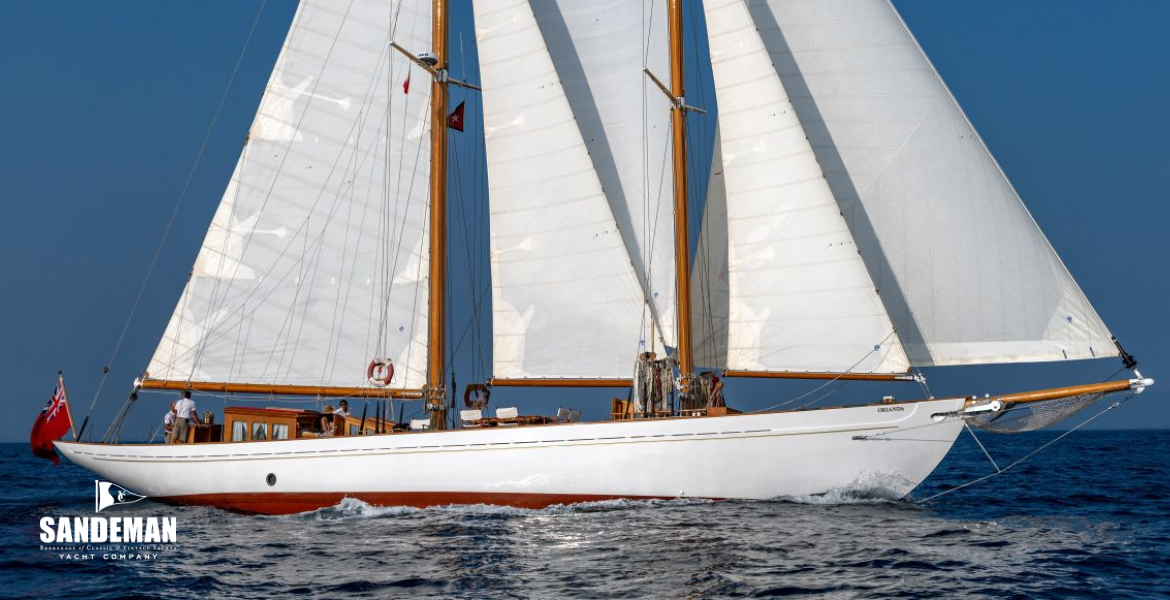
ORIANDA carries remarkable history and elegance in her strong bones and may be the perfect family yacht. Massively but finely built and impressively restored, maintained and upgraded, her interior volume is large for a yacht from this period and of this size: two double en-suite cabins, two twin cabins, and a separate crew cabin for three – all exuding pre-war style yet modern comforts; vast space on deck for dining, and sailing - though her staysail schooner rig requires little tending once set. ORIANDA received a new deck less than ten years ago, and a completely new rig in 2022. A classic yacht optimised to stay out of port and large enough to make this an option is a rare thing.
Interested in ORIANDA in more detail.
"ORIANDA was identified as a high-quality construction with regard to the hull, deck plan, masts, equipment, and interior fittings... It was evident that she was built by highly skilled and experienced craftsmen capable of adapting the robustness and construction techniques typical of Northern European workboats, fishing vessels, and transport vessels, to an elegant 1930s yacht. ORIANDA not only possesses an unusually robust hull and heavy displacement, unlike other comparable vessels, but also retains an innate grace and speed. The rig, designed to be sailed by a small crew, makes her easy to use and manoeuvre. The interiors showed excellent attention to detail, the choice of materials, and construction, which clearly appeared to be of high quality, especially in the original parts that were found to be of superior quality."
2024 and 2025
CANTIERE NAVALE DELL' ARGENTARIO, PORTO SANTO STEFANO, ITALY
- New horn timber
- Stern "opened" and all necessary wood elements replaced
- Rudder's metal components (stock, quadrant, all hydraulics) replaced with new
- All new sole boards
- New water tanks
2021-2022
CHANTIER PASQUI, VILLEFRANCHE, FRANCE
- Completely new Oregon pine and Sitka spruce rig
- Including standing and running rigging
- All new North sails
2015-2017
TECNOMAR, FIUMICINO, ITALY
- Completely new deck structure as described in CONSTRUCTION
- Other structural and systems work
2009-2010
TECNOMAR, FIUMICINO, ITALY
- Major refit
FROM 2023 SURVEY REPORT
"ORIANDA was built in 1937 for long-distance cruises in the North Sea. The hull... was built taking into account the designer's initial concept, which was to create a solid, robust vessel capable of undertaking any voyage in any sea in the world in complete safety and comfort."
HISTORY 1937-1940
For her designer, her commissioning owner, perhaps even her builder, RAGNA IV (as ORIANDA was launched) may have represented the culmination of many dreams.
RAGNA IV was the largest vessel then built by Carl “Jolle” Andersen’s Faaborg Skibs og Bådebyggeri yard, variously adept at producing wooden commercial (especially fishing) and pleasure vessels of all sizes and types. She was by far the largest design by highly regarded and well-connected Finnish born, Copenhagen resident ‘amateur’ yacht designer (one of Denmark’s leading public building architects; the son of a carpenter; and a very competent marine artist) Oscar W. Dahlström (1878-1970). And for her first owner, Ole Sundø (1874-1953) – the son of a northern Norwegian waters marine pilot, and a near neighbour of Dahlström in the fashionable North Copenhagen maritime suburb of Hellerup who rose to the top of the Egmont publishing/ media empire, embracing company founder Egmont Harald Petersen’s philanthropic ideals, in particular in sailing education for all via Kjøbenhavns Amatør-Sejlklub – RAGNA IV must have been a dream come true: a retirement present to himself fit for the seven seas. As ORIANDA, she remains a beautiful dream, and she has been that for many owners in her almost 90 years.
It's said that Dahlström struck up a 1930s correspondence friendship with William Fife Jr (“III”), and it is true that his two larger designs, ORIANDA and the ketch AKELA of 1951, bear some resemblance to Fife’s late period design for EILEAN (1936), more recently well known as “the Panerai yacht”, and heavily featured in Duran Duran’s early 1980s pop video for ‘Rio’. It may be no surprise then that ORIANDA sails very well under her refined staysail schooner rig.
Dahlström’s exacting specifications for a very stoutly built yacht to comply with the Norwegian Det Norske Veritas’s top scantlings classification, and his design brief (above), apparently caused the builder some headaches that might be recognised by present day shipwrights, but not perhaps imagined in the days when stocks of suitable lumber were perceived to be plentiful.
In a wonderful 2013 homage to Dahlström published in the Danish Old Yachts Association (DFÆL) journal ‘Klassisk Træbåd’, Carl Mangor takes up the story:
“[RAGNA IV] was built to Veritas Class 1, which placed great demands on boatbuilder Carl Andersen in Faaborg... Finding a suitable piece of oak 12 meters long alone took the boatbuilder three months. The planking was also to be in oak, but here one could make do with planks 8 meters long… Regarding the casting of the iron keel, Dahlstrøm himself told ‘Dansk Arbejde’ member magazine in 1937 that the boatbuilder had followed the model so closely that when the iron foundry in Odense turned up with the 15-tonne keel, it weighed 90 kg too little. This corresponded exactly to the weight of the keel bolts, so when they were in place, the keel weight was the planned 15,000 kg.”
RAGNA IV was Ole Sundø's replacement for RAGNA III, a Johan Anker International 12-Metre launched by Ankler & Jensen in 1909 as BRAND IV. Sundø's fourth RAGNA was launched at Faaborg with an 8-cylinder Ford petrol auxiliary engine, a popular manufacturer for Danish fishing vessels at this time, and rather unusually perhaps, a suit of sails made by Gowen of West Mersea, Essex, England. Initially she appeared with a bermudan foresail, its luff raised up the foremast, but this seems to have quickly changed to the forestaysail rig she’s known for.
The Second World War Nazi occupation of Denmark from April 1940 meant that Sundø’s time with RAGNA IV was to be sadly short. We don’t know how much if any of his planned long distance cruising and racing actually happened, but if none, she certainly made up for it post-war.
©Iain McAllister/Sandeman Yacht Company 2026
ORIANDA’s former charter agent, The Classic Yacht Experience, researched her long ownership history extensively. The following extract is a lightly edited version of their ORIANDA wartime and post-war history:
ORIANDA was commissioned in the waning days of a bygone era, when elegance was an integral part of supreme adventure under sail. Her history could easily be taken from a novel where Royals, military seizures, naval academies, and rock stars were all part of the plot. She has changed name four times, enduring WWII as well as surviving a fire. Many interesting characters have owned her, from a Greek ambassador to a songwriter receiving a rare Golden Record for the song he wrote on-board which sold more than a million copies. She has sailed across many oceans, ranging from the Baltic to the Atlantic – where she lived in the Caribbean for 20 years – to the Mediterranean. Her fascinating history contributes to an aura of mystery and charm, ultimately enhancing her beauty and appeal.
RAGNA IV was found in 1944 by Danish Baron Johan Otto Raben-Levetzau in a state of disrepair after being seized by Nazi forces and ultimately abandoned on the shores of Denmark without her masts or rig. Soon after she was sold by Ole Sundø to the Baron.
She then enjoyed a major refit at Svendborg. Her masts which had been removed to support the war effort were replaced from some of the rarest trees from the Baron’s Aalholm Castle Estate.
Under the new name SABINA and painted navy blue, Baron Raben-Levetzau took her to Sweden where she cruised and raced, though her port of registry remained Nysted in southeast Denmark.
It is thought that in March 1952, young Sterling Hayden, later to become a Hollywood star, crewed aboard SABINA for a voyage to Newport Beach, Los Angeles. His 1964 biography, ‘Wanderer’ gives a descriptive portrayal of the highs and lows of working as a ‘green’ crew member.
SABINA was then sailed by Captain Mathieson and a crew of three to the Mediterranean and the start of a charter life there. She explored the south of France until 1960/61, when Baron Raben-Levetzau sold her to the Greek Consul General in Sweden, Stergios C. Souyouldjoglen.
According to the late son of Baron Raben-Levetzau, Sabina was then sailed from France to Germany for a significant refit. Whilst her original Staysail Schooner rig was retained, her masts were changed to steel as they remained for many years (now restored to Oregon pine and Sitka spruce). During the Greek diplomat’s ownership, SABINA was often in Greece, in particular the small port of the island of Hydra in the South Peloponnese, and often took part Aegean Boat Rallies. The family was very social and usually sailed with numerous friends from Greece and Sweden. The yacht was sold around 1969 to a Mr Draikis, a senior executive in Ralli Brothers, who eventually sailed her to the south of France.
During the 1970s she was sold in Marseille to Frenchman George Le Bihan who renamed her ALOHA OHE, believed to mean ‘Fair Winds’ in Polynesian.
She was then sold at Tortola to a French couple who, apparently inspired by ‘Orianda House’ in Crimea, decided to adopt this name for the yacht. In 1976 as ORIANDA she took part in the independence bicentenary celebration of the Caribbean States on the Hudson River, New York. Not much more is known of this period of the yacht’s life other than the fact that the owner was a relatively well-known filmmaker in France.
ORIANDA is then believed to have continued to charter in the British Virgin Islands together with MANDA and PANDA, then only large yachts available for charter in the Caribbean.
In 1981 ORIANDA was sold to Neil Peart, the drummer powerhouse of the Canadian rock band Rush, who wrote in his autobiography:
“[One] night as we lay at anchor in Virgin Gorda, Geddy [Geddt Lee, Rush keyboards, bass and vocals] and I went down below after dinner, and I showed him some of the work that I had been doing. I had written “The Analog Kid” as sort of a companion piece to “Digital Man”, which had been written last fall up at Le Studio. He liked it, and we discussed different ways it could be treated musically. As we often do, we thought it would be interesting to take the opposite approach to what the lyrics would suggest; make it a very up-tempo rocker, with some kind of a dynamic contrast for the choruses. We also looked at a rough version of “The Weapon” that I had put together, and agreed that it would need some more work. He told me what he liked, and what he didn’t like, and gave me some good points to go to work on. We put an end to the “shoptalk” and went back to our holidays.”
Peart and his friends owned ORIANDA until 1987, when she was sold to Peter Phillips at Tortola. A day after the sale completed, her stern caught fire, “She was at anchor in the harbour of West End Tortola. The party had just gone ashore and the next thing, everyone in the bay is charging across to ORIANDA with their buckets and fire extinguishers… ORIANDA had numerous friends in the British Virgin Islands, she represented them during the American Bicentennial celebrations in New York, and there were a couple of very determined West Indian guys who just wouldn’t give up. They formed a chain of buckets and fire extinguishers and went on fighting. In the end, they saved her… Within two days I had gone from being the proud owner of a classic yacht to a man with a nightmare problem”.
Phillips was left with only partial insurance cover. To raise the balance required to restore the boat, he threw a fundraising party on board and was able to raise sufficient funds to save her. The restoration took approximately five months, with the workforce at times counting as many as sixteen people. ORIANDA was restored to her former glory.
During Peter Phillips’s ownership, he had some, “great adventures in the Caribbean, UK and Mediterranean classic Regattas with ORIANDA”. He also conducted a fair amount of work on her, including new deck, pilot house, machinery, systems, spars and sails. Her cruising waters had ranged from her old haunts of the Baltic to the Caribbean to New York, and from New York to the English Channel.
After the 1990 La Nioulargue at Saint Tropez, Peter Phillips sold ORIANDA to a Spanish real estate developer who used her for gentle family sailing out of Denia, exploring the Balearics, and competing in Mediterranean classic yacht regattas until she entered current ownership in 2009.
Since 2009, until relatively recently ORIANDA was operated in present ownership for both family cruising and classic racing, and as a charter yacht, but in recent seasons she has sailed only privately. Much love, skill, and of course funds have been lavished on ORIANDA since 2009, particularly in major refits at Tecnomar, near Rome 2009-2010, and at Cantiere Navale dell’Argentario, Porto Santo Stefano, 2015-2017 (including a new deck), and 2024-2025 (structural and other work) described in RESTORATION, above), and a completely new rig in 2022 by Chantier Pasqui of Villefranche, France, including all new sails by North.
ORIANDA may be in her best shape since 1937.
- 50-60 mm Iroko and mahogany planking on oak frames
- Planking galvanised nail fastened to frames
- Particularly strong longitudinal structure at forward sections
- The 150 mm oak frames are pocketed and galvanised pinned to the wood keel
- Doubled stem
- Massive, closely spaced 150 mm oak floors (no metal floors)
- 100 x 250 mm Oak beam shelf
- 60 mm partial internal hull ceilings as extended bilge stringers/ beam shelf
- Ceilings are tied to the planking with galvanised rod
- Galvanised iron hanging knees
- Oak wood keel and keelson
- Cast iron ballast keel c.25 tonnes
- Galvanised iron keelbolts
- Stainless steel mast step structure
- 16 x 55 mm Teak laid deck on 18 mm mahogany marine ply substrate (c.2017)
- Varnished teak superstuctures believed mostly original
- Stainless steel chainplates
GENERAL
- Teak laid on marine plywood deck
- c.400 mm Bulwarks with teak capping rails
- Bulwark stanchions are the extension of the frames
- Varnished teak mostly original superstructures
- Deck hardware of bronze and stainless steel
FROM AFT
TAFFRAIL/ AFT DECK/ AFT SIDE DECKS
- Bronze mooring fairleads port & starboard
- Ensign staff socket
- Passarelle socket
- Mainmast backstay chainplate
- Mainsheet horse
- Raised, laid teak lazarette hatch
- Bronze cowl vents port & starboard
- Chromed bronze self-tailing mainsheet winch to port
- Socket for main boom crutch
- Large bronze double bollards port and starboard
COCKPIT
- Well type
- Seating on side decks
- High coamings port & starboard
- Helm/ large steering gear box forward
- Traditional ship's wheel
- B&G MFD, repeaters, and engine controls concealed in box
- Traditional brass steering compass binnacle
- Engine throttle control
- Chart table to starboard
- Front loading refrigerator
- Under sole access to steering and emergency steering point
PILOT HOUSE (No access below)
Exterior
- Sliding hatch in roof
- Removable cushions on roof port & starboard
- Double entrance doors
- 3 x Windows port & starboard
- 3 x Windows forward; outboard sashes slide open
Interior
- Ship's electrical panels port & starboard aft
- Button leather upholstered benches port & starboard
- Teak laid sole
- Sole hatch access to engine space
- Barometer
- 3 x Deckhead lights
- 2 x 'Cabin' type reading lights
DECK FORWARD OF PILOT HOUSE
- Forward facing seating with armrests
- Running backstay tackles port & starboard outboard
- Associated chromed self-tailing winches port & starboard
MAIN COMPANIONWAY SCUTTLE
- Sliding hatch in roof
- Double entrance doors
- 2 x Windows port & starboard
- Lean-to skylights port & starboard
MAINMAST POSITION
- Liferaft stowage to starboard
- Mainsheet sheeting tackles forward
- Chainplates and leathered bottle screws outboard port & starboard
- Bronze pin rails in widened cap rail port & starboard
- Bronze mooring fairleads port & starboard
RAISED SALOON SKYLIGHT
- Folding dining table over
- Director's chairs seating for 6
RAISED SKYLIGHT OVER FORWARD GUEST CABINS
COMPANIONWAY SCUTTLE TO GALLEY/ CREW ACCOMMODATION
- Sliding hatch in roof
- Double entrance doors
- Windows port & starboard
- Lean-to skylights port & starboard
FOREMAST POSITION
- Chainplates and leathered bottle screws outboard port & starboard
- Bronze pin rails in widened cap rail port & starboard
- Bronze mooring fairleads port & starboard
FOREDECK
- Staysail boom sheeting tackles
- Stowage boxes forward of foremast
- Butterfly skylight over crew cabin
- Butterfly skylight over crew WC/ shower
- Windlass
- Copper capped bowsprit bitts
- Bronze mooring fairleads on rail port and starboard
- Panama fairleads port & starboard
- starboard: for anchor chain
- port: for yankee furling line
GROUND TACKLE
- Muir vertical windlass; chain gipsy and warping drum
- Galvanised CQR-type 53 kg bower anchor
- Bower anchor stowed in custom launcher at starboard bowsprit
- 130 m of 16 mm Galvanised anchor chain
- 2nd CQR type 35 kg anchor stowed on deck
- 10 m of 16 mm Galvanised anchor chain
ORIANDA can accommodate up to 8 guests in 4 cabins: 2 double cabins each with an en-suite head and 2 twin cabins with a shared head. She can accommodate up to 3 crew, and offers all the comforts of a modern private yacht without giving up the beauty and attention to detail of her 1930s origins.
SUMMARY
- Owner/ guest accommodation for up to 8 in 4 cabins
- All cabins have:
- air-conditioning
- skylights for light and natural ventilation
- electric fans
11 x STEPS DOWN FROM MAIN COMPANIONWAY TO AFT LOBBY
FORWARD TO SALOON
To port:
- Leather upholstered L-settees as dining area
- Drop leaf table
- Much stowage/ bookshelves outboard
- Sideboard with drawers and lockers forward
To starboard:
- Sideboard with drawers and lockers aft
- Leather upholstered settee
- Lockers outboard
- Large butterfly skylight in deckhead with period lamp
- Deckhead lights
- Bulkhead lights
PASSAGE FORWARD
- Deckhead light
- 2 x Guest cabins with upper and lower berths
- 1 x Cabin can be converted into a double by closing the upper bunk
- Deckhead and reading lights
- Electric fans
- Banquettes
- Stowage
GALLEY FORWARD
Cooking Area to Port
- Bosch hob; Siemens oven
- Front loading refrigerator
- Drinks cabinet refrigerator
- Chest freezer
- Deckhead lights
- Electric fan
Crew Mess to Starboard
- 2 x Banquettes
- Folding table
- Deckhead lights
- Electric fan
CREW ACCOMMODATION FORWARD
- Access from forward companionway scuttle
- 6 x steps down
- or from forward passage
- Single berth to port
- top and bottom berth to starboard
- Deckhead lights
- Reading lights
- Stowage
- 3 x Electric fans
- Butterfly skylight in deckhead
WC/ Shower Compartment Forward
- Jabsco manual WC
- Inset sink; mixer tap
- Stowage
- Butterfly skylight in deckhead
AFT ACCOMMODATION SUMMARY
- Aft accommodation lobby
- 2 x Queen berth, en-suite double cabins
- Port en-suite also has access from lobby as day head
- Starboard WC/ shower compartment as day head or fwd cabins head
TO AFT ACCOMMODATION VIA AFT LOBBY
STARBOARD AFT (OWNER) EN-SUITE CABIN
- 'Queen' berth
- Small banquette
- Hanging locker
- Book shelves
- Bulkhead/ reading light
- Chromed bronze hull port
- Half skylight in deckhead
- Electric fan
- Rush gold disc
En-suite
- Planus Smart electric WC
- Mahogany top surface
- Inset sink
- Mixer taps
- Shower with teak grating sole
PORT AFT EN-SUITE CABIN
- 'Queen' berth
- 2 x Banquets
- Hanging locker
- Book shelves
- Bulkhead/ reading light
- Chromed bronze hull port
- Half skylight in deckhead
- Electric fan
- Rush gold disc
Ensuite/ shared day head/ forward guest head
- Planus Smart electric WC
- Mahogany top surface
- Inset sink
- Mixer taps
- Shower with teak grating sole
- Deckhead light
SHARED DAY/ FORWARD GUEST HEAD
- Planus Smart electric WC
- Mahogany top surface
- Inset sink
- Mixer taps
- Shower with teak grating sole
- Deckhead light
RIG
Masts and spars by Chantier Pasqui, Villefranche (2022)
- Oregon pine / Sitka spruce
- Mainmast; 2 x sets of spreaders
- Main boom
- Foremast; 1 x set of spreaders
- Fore boom
- Staysail boom
- Bowsprit
Standing rigging
- 'Atlantic' 7 x 7 stainless steel (2022)
- Chromed bronze bottle screws and toggles
Running rigging
- New 2022
SAILS
Dacron by North Sails (2022)
- Mainsail
- Fore staysail
- Fisherman
- Boomed staysail
- Yankee on roller furler
Older sails
- Gennaker
- Spare fisherman
CANVASWORK
Covers for
- Superstructures
- Sails on booms
- Mid deck awning
MECHANICAL
- Cummins BTA 5.9 6-Cylinder diesel, 305 hp
- V-drive to shaft drive train to aperture propeller
- 5-Blade bronze Max Prop feathering propeller
- Max Speed 9 Knots
- Cruising Speed 7 Knots
- Hours (late 2025) 6670
- Engine and Generators Consumption: 40 L/ hour
MECHANICAL/ ELECTRICAL
- Onan 15 kW Generator
- Fisher Panda 10 kw Generator
ELECTRICAL
- Wiring of commercial vessel quality
- 2 x Power converters: 220 V, 24 V, 12 V
- Shore power 220 V
- 2 x Exide Optima engine start batteries (2021)
- Mastervolt 24 V Lithium service batteries system (2023)
- Mastervolt Combi battery charger
- Mastervolt Combi inverter
TANKAGE
Water:
- Schenker 120 L/ h watermaker
- 2 x 1200 L / 264 L Stainless steel water tanks
- Pressure water system
- Jabsco double pump and expansion vessel
- 80 L Stainless steel hot water tank
Fuel:
- 6 x Stainless steel fuel tanks
- Tank capacity 1400 L / 308 Gals total
Waste:
- Grey water system with diaphragm auto float switch transfer pump
- Sink drain pumps: Whale Gulper 220 with in-line filters
AIR CONDITIONING
Dometic independent AC Fan coils in each cabin
NAVIGATION
At Helm:
- Magnetic steering compass in brass binnacle
- B&G Zeus 3S touch screen multi function display
- B&G Repeaters: log, depth, wind
- B&G Autopilot, Hydraulic Drive
At Pilot House:
- B&G Zeus 3S touch screen multi function display
Radar:
- B&G Radome at mainmast
COMMUNICATIONS
- 'Recent' DSC VHF DSC radio transmitter receiver
- Sailor RT5022 VHF DSC radio transmitter receiver
- 2 x Proxell TT-446 handheld VHF radio transmitter receiver
- Emergency tiller
Life saving:
- Zodiac 8-Person grab bag
- Accusat 406 MHz EPIRB
- Canister liferaft
- 2 x Lifebuoys
Bilge pumping:
- 3 x Electric bilge pumps: 1 x impeller; 2 x submersible
- Manual Whale MK3 Pumps
Fire fighting:
- TBC
- 4.5 m Joker Boats RIB Tender (2017)
- Scorprega Brava pump
- 40 hp outboard motor
- Water-Ski equipment
- Wake-board
- Doughnut inflatable
Contact us to discuss ORIANDA in more detail.
These particulars have been prepared from information provided by the vendors and are intended as a general guide. The purchaser should confirm details of concern to them by survey or engineers inspection. The purchaser should also ensure that the purchase contract properly reflects their concerns and specifies details on which they wish to rely.
